Class 4 Cost Estimate: Study Estimate with Equipment-Factor Methods
Moving beyond screening to the first equipment-based estimate: Class 4 uses your equipment list and proven factoring methods to produce a project cost within ±30–50%. Here's exactly how it works.
How Kpex implements Class 4 following AACE 18R-97
Kpex 2G guides the cost engineer through every step of the Class 4 workflow — from scope input to indexed, location-adjusted output — enforcing the AACE recommended methodology at each stage. The platform validates inputs, applies the correct indices automatically, and generates a documented Basis of Estimate aligned with AACE 18R-97.
What Is a Class 4 Cost Estimate?
A Class 4 Study Estimate is the first estimate built from an actual equipment list. Produced when engineering is approximately 1–15% complete (typically at the end of a Conceptual Study or early Pre-FEED), it brings cost accuracy into the −30% to +50% range.
Where Class 5 asks "Is this worth doing?", Class 4 asks "How much will the major systems cost, and what is the project structure?" It is the estimate used to decide between process route alternatives, to size contingency reserves, and to justify proceeding to FEED.
The Lang Factor Method
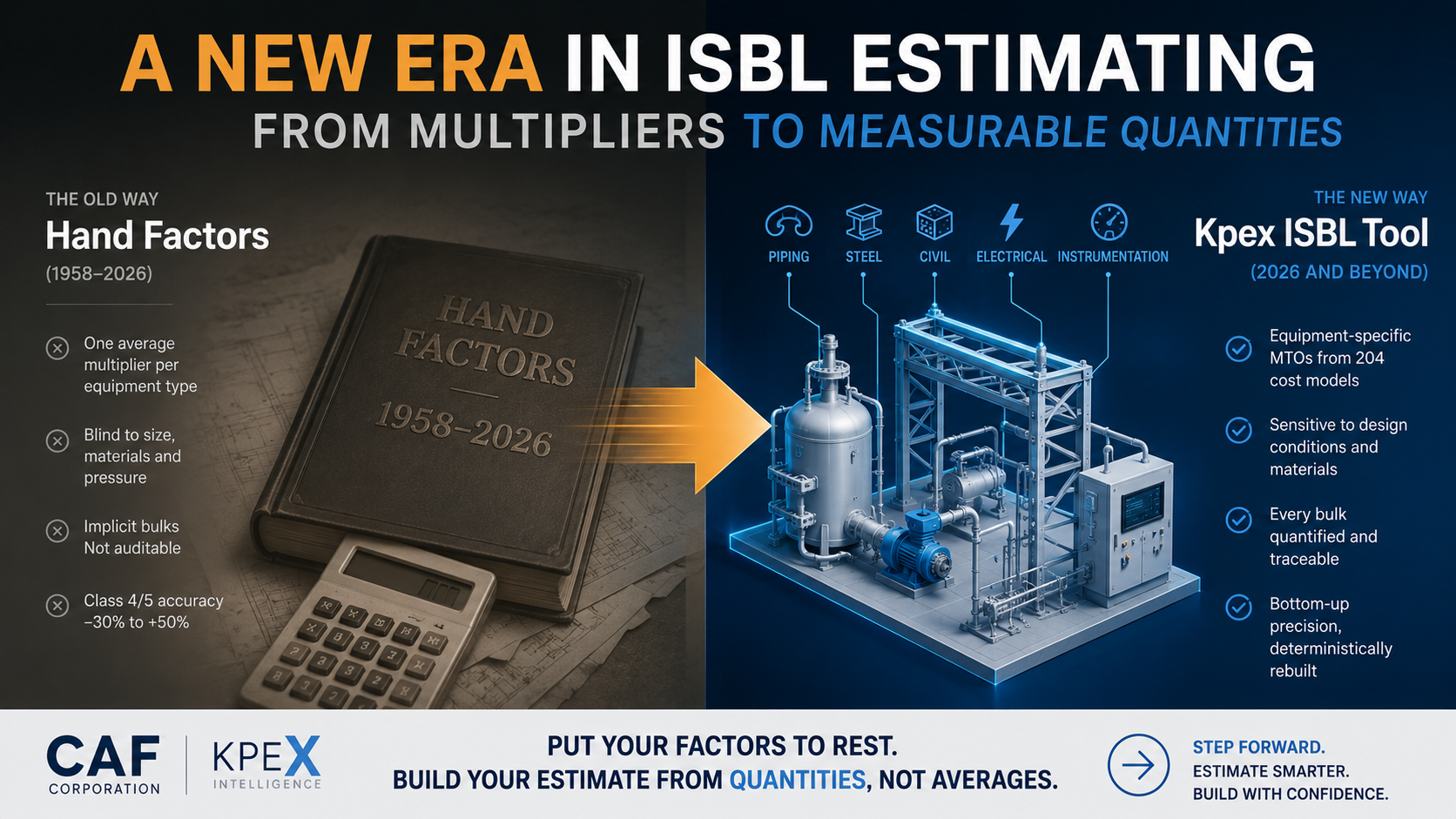
The dominant technique for Class 4 estimation is the equipment-factor method, most commonly applied using Lang Factors (introduced by Herbert Lang in 1948 and refined by Hand, Baumann, and others).
The principle: Total Installed Cost (TIC) is a predictable multiple of Purchased Equipment Cost (PEC), because the ratio of civil, structural, piping, electrical, instrumentation, insulation, painting, and indirect costs to equipment cost is relatively stable within a given plant type.
Direct Cost (DC) = Σ PEC × fdirect
Indirect Cost (IC) = DC × findirect
Standard Lang Factors (USGC, 2020 basis)
| Plant Type | Lang Factor | Typical Industries |
|---|---|---|
| Fluid processing | 3.1× | Refineries, gas processing, LNG |
| Mixed fluid-solid | 3.6× | Petrochemicals, specialty chemicals |
| Solid processing | 4.7× | Mining, mineral processing, fertilisers |
Class 4 Workflow — Step by Step
Step 1 — Define WBS Areas
Organise your estimate using a Work Breakdown Structure. At Class 4 level, areas are typically process areas or systems (e.g., Area 100 — Feed Pre-treatment, Area 200 — Reaction, Area 300 — Separation). Kpex provides a WBS builder integrated directly into the equipment list form.
Step 2 — Build the Equipment List
For each WBS area, list the major pieces of equipment. Kpex supports three equipment pricing sources:
- OEM / Proprietary — Vendor budgetary quotes or published list prices
- Quotation — Formal budget quotations received from suppliers
- Kpex Module A — Equipment cost models from the Kpex database (power-law curves calibrated to 2025 CEPCI, USGC basis)
Step 3 — Price Each Equipment Item
For each item, record: description, equipment type/family (e.g., A.1.1 — Compressor, A.1.3 — Heat Exchanger), quantity, and unit purchased cost. Module A lookups include weight (tonnes) and erection manhours — data that feeds directly into Class 3/2 estimates later.
Step 4 — Apply Lang Factor to Get Direct Cost
Multiply the total purchased equipment cost by the appropriate Lang Factor for your plant type. This gives the Direct Field Cost (DC), which covers all field-installed materials and labour (civil, structural, piping, electrical, instrumentation, insulation).
Step 5 — Add Indirect Costs
Add project indirect costs as a percentage of DC or as fixed amounts:
- Engineering & Home Office (typically 8–15% of DC)
- Construction Management (5–10%)
- Procurement / Expediting (2–4%)
- Start-Up & Commissioning (1–3%)
- Owner's Costs (varies)
- Contingency (15–25% of TIC at Class 4)
Step 6 — Apply LFI and CAI
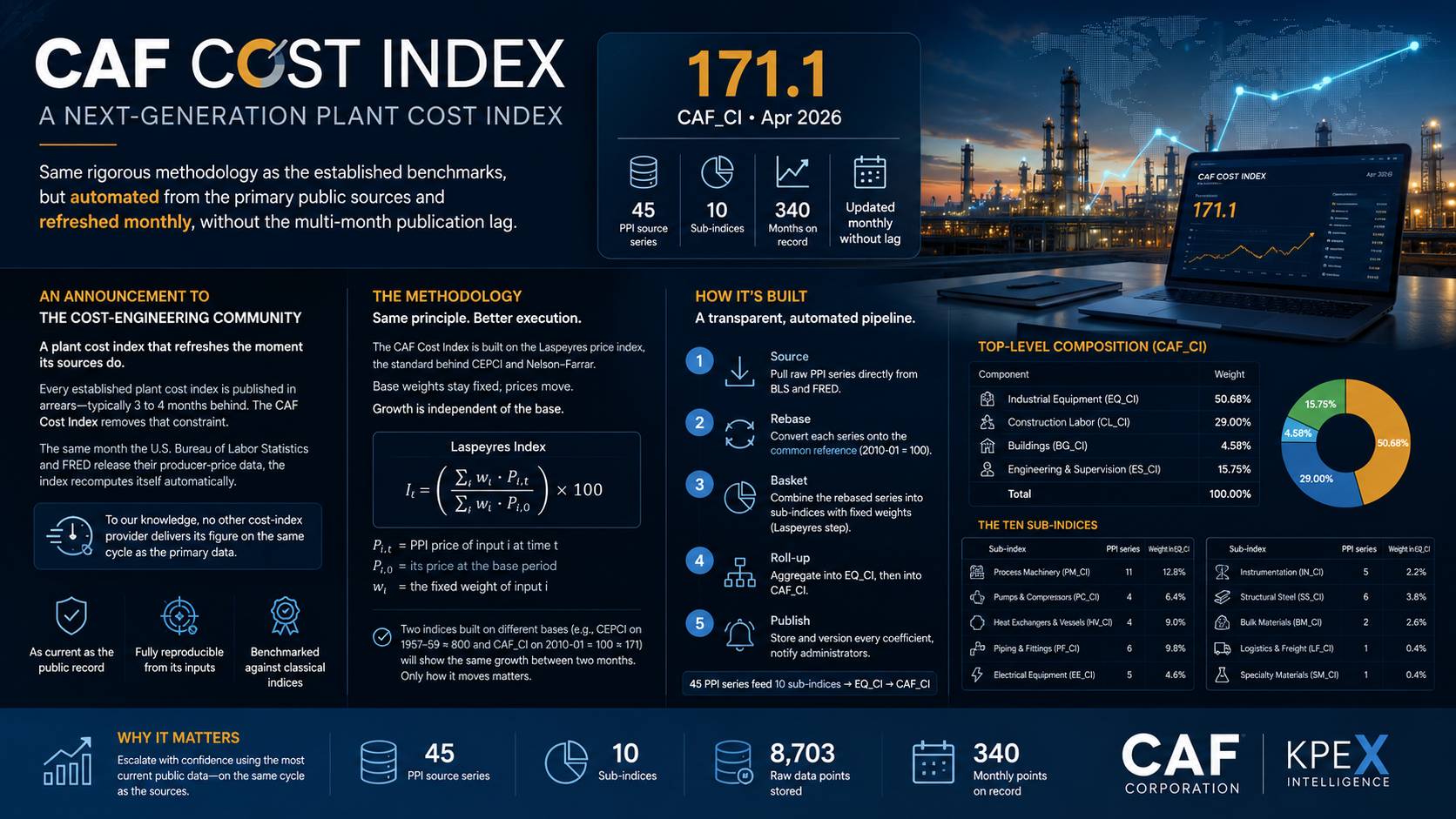
The Lang Factor and equipment costs are typically on a USGC basis. Apply Z.4 LFI for your project country and Z.5 CAI to escalate from the cost basis year to the project execution year.
Step 7 — Document the Basis of Estimate
Record all assumptions: equipment pricing source, Lang factor selected and rationale, cost basis date, CEPCI reference, LFI factor applied, contingency methodology, and scope exclusions.
Equipment List Structure in Kpex
Kpex stores each equipment item relationally, with the following data captured per item:
| Field | Description |
|---|---|
| WBS Area | Process area or system (code + name) |
| Description | Equipment tag and service name |
| Equipment Type | AACE/Kpex family code (e.g., A.1.1, A.1.3) |
| Source | OEM / Quotation / Kpex Module A |
| Quantity & Unit Cost | Purchased cost in project currency |
| Weight (te) | Equipment weight from Module A lookup |
| Manhours | Erection manhours from Module A |
| Attachments | Vendor quotation PDFs / datasheet files |
How Kpex Implements Class 4 — AACE 18R-97 Compliance
- Equipment cost models (Module A) — 12+ equipment families with power-law curves calibrated to 2025 market data, USGC basis
- Automatic Lang Factor — Select plant type (fluid / mixed / solid) and the platform calculates DC from PEC automatically
- Indirect cost templates — Pre-loaded industry-standard indirect cost percentages, user-adjustable
- LFI × CAI integration — Country and time adjustment applied at estimate level
- Relational storage — Equipment items stored in structured tables, enabling filtering by family, area, or source
Class 4 in Kpex — Step by Step in the Platform
- Create a new estimate → select Class 4 – Study Estimate. Kpex loads the Lang Factor workflow and prompts for plant type selection.
- Define WBS areas using the built-in WBS builder (e.g., Area 100 — Reaction, Area 200 — Separation). Each area groups its equipment independently.
- Add equipment items per area. For each item, choose the pricing source:
- Kpex Module A — pulls the cost model for the selected equipment family (B1000 Compressors, D1000 Heat Exchangers, F1000 Pumps…), including weight and erection manhours
- OEM / Vendor quote — enter the budgetary price directly
- Quotation — attach the vendor PDF and enter the confirmed figure
- Select plant type (Fluid / Mixed / Solid) → Kpex applies the Lang Factor (3.1×, 3.6×, 4.7×) to calculate Direct Field Cost automatically.
- Review indirect costs. Kpex pre-loads industry-standard indirect percentages (Engineering & HO, Construction Management, Start-Up…); all are user-editable.
- Select country and cost year → Z.4 LFI and Z.5 CAI are applied at estimate level, adjusting the full TIC in one step.
- Export the Basis of Estimate with equipment list, Lang Factor rationale, index values, and AACE Class 4 accuracy declaration.
AACE References
- AACE 18R-97 — Cost Estimate Classification System
- AACE 59R-10 — Development of Factored Cost Estimates
- Lang, H.J. (1948) — Simplified Approach to Preliminary Cost Estimates — Chemical Engineering
- Hand, W.E. (1958) — From Flow Sheet to Cost Estimate — Petroleum Refiner