Kpex · Module C: A Cost Model for Every Facility, in One Platform
Module C is the only place an estimator can put a credible, defensible number on a refinery, a rail line, a hospital, a solar farm, a mine, or a nuclear plant — early, fast, and on one consistent basis. Here is how it works, and why nothing else on the market does the same.
Explanation AI Generated
A Cost Model for Every Facility, in One Platform
Module C is the only place an estimator can put a credible, defensible number on a refinery, a rail line, a hospital, a solar farm, a mine, or a nuclear plant — early, fast, and on one consistent basis. Here is how it works, and why nothing else on the market does the same.
The gap every estimator knows
A concept lands on your desk on Monday. A new plant, a terminal, a treatment works — and the client wants a number by Friday, not next quarter. There is no detailed engineering yet. The equipment list is still a wish. And the tools you would normally reach for were each built for one corner of the problem: one is a process simulator, another only speaks oil and gas, a third only understands buildings. None of them speaks the full language of capital projects.
Module C was built to close that gap.
What Module C actually is
Module C is Kpex’s library of facility-level parametric cost models. Rather than building a facility up from thousands of line items you do not have yet, you describe it by what truly drives its cost — capacity, throughput, floor area, length, installed power — and Module C returns a structured, benchmarked capital cost, broken down the way an estimator expects to read it.
One methodology, applied to the whole built world
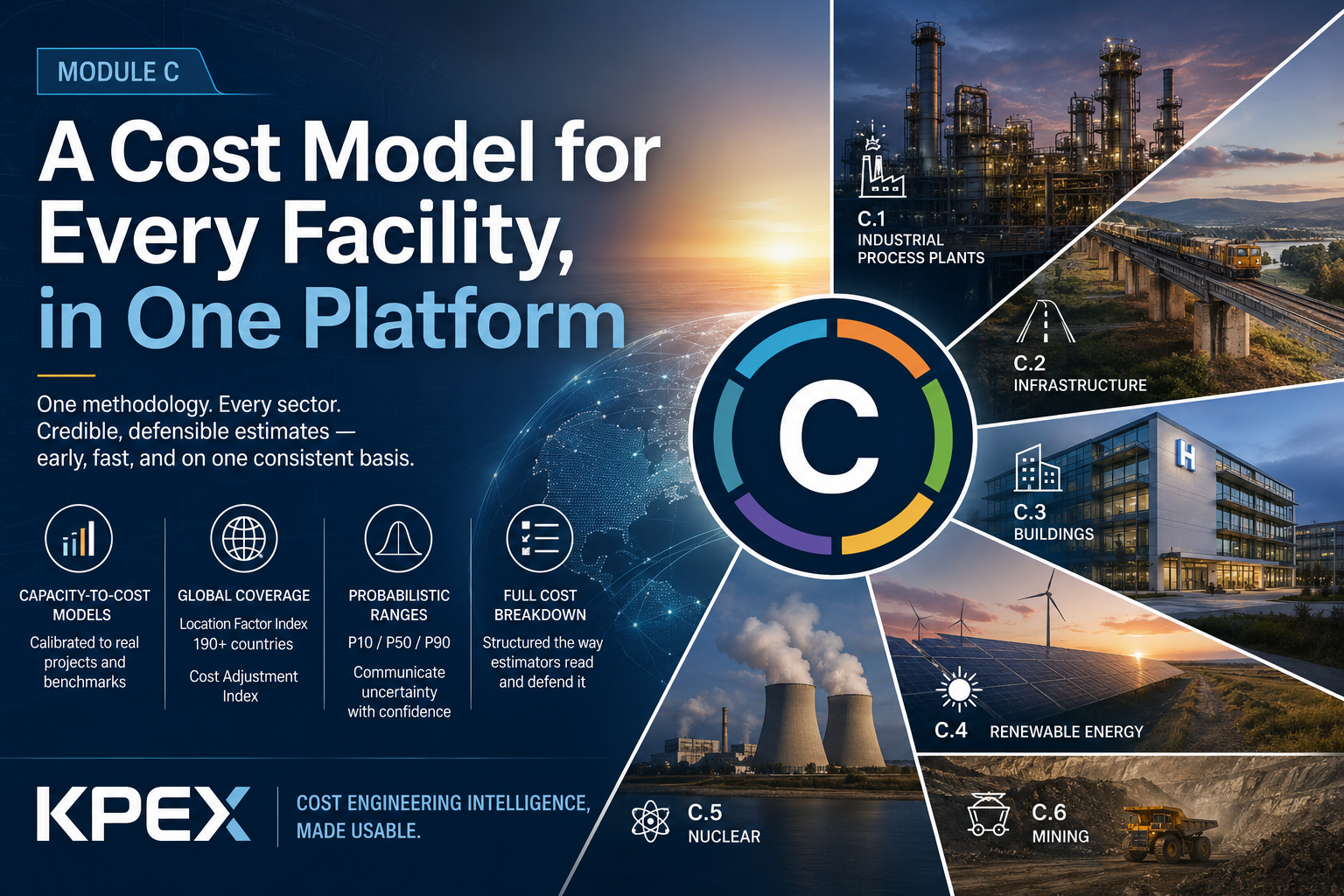
What sets it apart is the breadth. Module C spans the entire universe of capital projects, not a single slice of it:
To our knowledge, no other estimating tool on the market covers that full spectrum at the facility level. Process simulators stop at the equipment. Sector tools stop at their sector. Module C is deliberately horizontal — one cost basis, one platform, applied to whatever the project happens to be.
Rigour you can defend
Behind every model is a capacity-to-cost relationship calibrated against real projects and published benchmarks, expressed as transparent parametric curves — not a black box. Each estimate returns as a full cost breakdown structure rather than a single lump sum, and each one carries a probabilistic range (P10 / P50 / P90) so you communicate uncertainty honestly instead of a false-precision point.
Every output is anchored to the AACE cost estimate classification, so a Module C result maps cleanly to a Class 5-to-Class 3 estimate and its expected accuracy. Location is handled by CAF’s Location Factor Index across 190+ countries; escalation, by the Cost Adjustment Index — so a curve derived in one place and year moves to your project’s place and year. And because Module C links to the OPEX and decommissioning (ABEX) models, the figure you produce is the starting point of a full lifecycle view, not just a capital number.
A cost model for the whole built world — and it is yours to use.
What it means for you
For the estimator: an order-of-magnitude number for almost any facility in minutes, complete with the breakdown, the range and the sources to stand behind it. For the project manager or owner: the ability to test a concept, compare options and sanity-check a bid before committing engineering hours. And for a portfolio that might hold a refinery, a substation and a hospital at once — one consistent, comparable basis across all of it.
Cost engineering intelligence, made usable
Kpex is a cost-intelligence platform: methodology built by estimators, made usable for the people who have to produce the number and defend it. Module C is where that intelligence meets the real breadth of what our clients build. It is not a calculator bolted onto a spreadsheet — it is a cost model for the whole built world.