Module Z: the calibration layer behind every Kpex estimate
Labor rates, location and time-adjustment indices, and a full set of project assessment tools, integrated into a single ecosystem. This is what sits behind every figure the platform delivers.
Kpex Insights · Platform structure
Module Z: the calibration layer behind every Kpex estimate
Labor rates, location and time-adjustment indices, and a full set of project assessment tools, integrated into a single ecosystem. This is what sits behind every figure the platform delivers.
When people talk about a cost estimating platform, the attention usually goes to the visible cost models: pumps, turbines, process plants, highways, substations. But no cost model is reliable unless it is calibrated to the actual location, timing, and conditions of the project being evaluated.
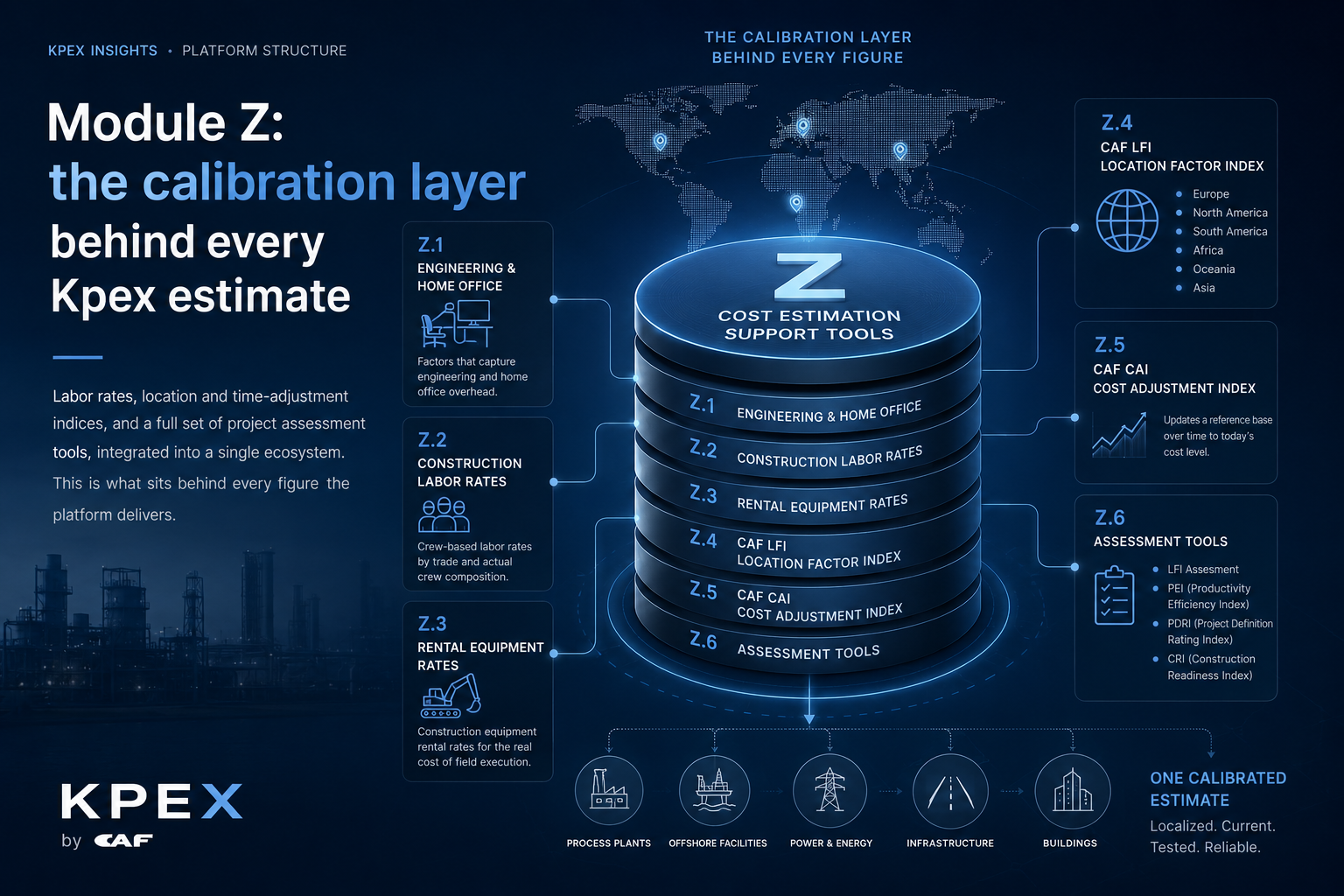
That is the role of Module Z — Cost Estimation Support Tools: the set of databases, indices, and assessment tools that adjust, validate, and give context to every figure Kpex produces. Without Module Z, a cost model is just a number. With it, that number is localized, current, and tested against the project's real maturity.
What Module Z contains
Z.1 · Engineering & Home Office
Factors that capture engineering and home office overhead applied on top of direct costs, so this component doesn't get estimated by guesswork on every single project.
Z.2 · Construction Labor Rates
The crew-based labor rate database: costs structured by trade and actual crew composition, not a generic average rate, but real crews applicable to execution.
Z.3 · Rental Equipment Rates
Construction equipment rental rates, the natural counterpart to crew rates for sizing the real cost of field execution.
Z.4 · CAF LFI (Location Factor Index)
CAF's proprietary location factor index, which translates a reference cost to the real conditions of any site in the world, covering six major regions:
Europe · North America · South America · Africa · Oceania · Asia
Z.5 · CAF CAI (Cost Adjustment Index)
The cost adjustment index that updates a reference base over time, so an estimate from three years ago can speak the same language as today's budget.
Z.6 · Assessment Tools
Four tools that answer the same question from different angles: under what real conditions is this project actually being estimated or executed?
- CAF LFI Assessment — applied validation of the location factor.
- CAF PEI (Productivity Efficiency Index) — real productivity efficiency in the field.
- CAF PDRI (Project Definition Rating Index) — how mature the project definition really is, with seven specific variants: industrial, small industrial, infrastructure, small infrastructure, buildings, small buildings, and Oil & Gas EPC.
- CAF CRI (Construction Readiness Index) — actual readiness to start construction.
What no other system brings together
You can find labor rate databases on the market. You can find location factor tables. You can find project maturity assessment methodologies like PDRI. But you find them separately, from different providers, with different definitions, that have to be manually reconciled before the result can be trusted.
Module Z brings all of it together — labor, equipment rental, location, time adjustment, and all four assessment tools — under one methodology, one WBS/CBS structure, and one platform. That is what makes every Kpex cost model more than a theoretical figure: it becomes an estimate calibrated to the project's real location, timing, and maturity. That all-in-one combination is what doesn't exist today in any other database or estimating tool on the market.
Module Z is rarely the first thing you notice when you open Kpex, but it's what makes everything else — from a process plant cost model to an offshore facility valuation — more than an isolated number.