Cost models for CO2 capture, liquefaction and shipping
The development of a maritime CO₂ transport chain enables flexible, scalable, and geographically independent CO₂ management solutions for Carbon Capture and Storage (CCS) and Carbon Capture and Utilization (CCU) projects. The liquid CO₂ (LCO₂) shipping value chain integrates onshore and offshore infrastructure to allow the collection, conditioning, temporary storage, and transportation of captured CO₂ to permanent sequestration sites or utilization industries. The configuration options illustrated below represent the principal operational pathways for transporting LCO₂ from emission sources to final sinks.
Model 1
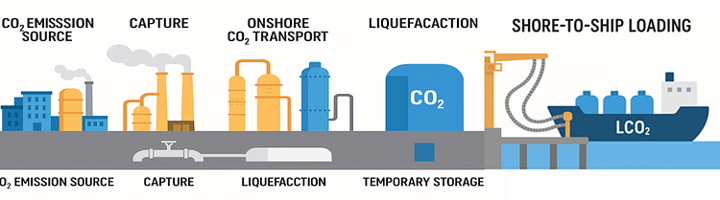
Onshore CO₂ Capture, Conditioning, Temporary Storage, and Shore to Ship Loading
- CO₂ Emission Source and Capture
Industrial facilities—such as power plants, refineries, petrochemical units, steel mills, or cement plants—act as primary CO₂ emission points. Post-combustion, pre-combustion, or oxyfuel capture technologies are implemented to extract CO₂ from flue gas streams.
- Onshore CO₂ Transport
- Once captured, CO₂ is conveyed to a central liquefaction terminal via:
- Pipeline networks,
- Truck loading systems, or
- Rail transport, depending on distance, volumetric flow, and project scale.
- Once captured, CO₂ is conveyed to a central liquefaction terminal via:
- Liquefaction and Buffer Storage
The CO₂ is cooled and pressurized to achieve LCO₂ conditions (typically −50°C / 7 bar). Liquefaction units are followed by storage tanks that serve as operational buffers to ensure continuous supply to marine carriers.
- Shore-to-Ship Loading
Marine loading arms or cryogenic flexible hoses enable the controlled transfer of LCO₂ from onshore tanks to purpose-built CO₂ carriers at export terminals.
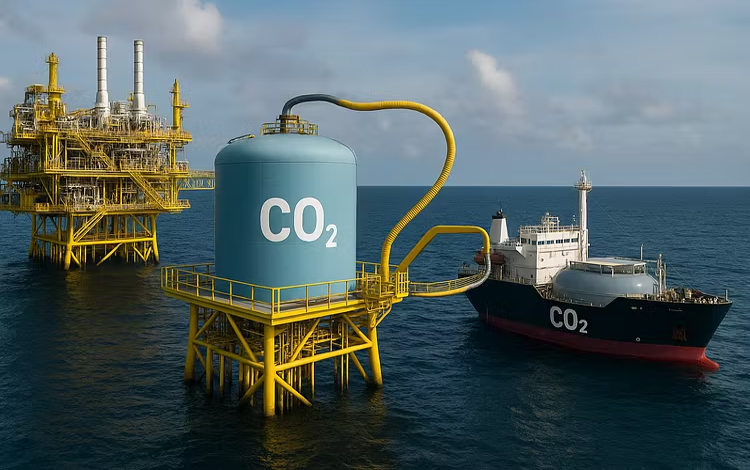
Model 2
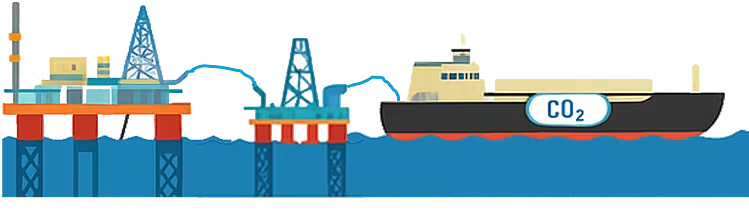
Offshore Capture and Intermediate Storage
For offshore oil & gas installations with embedded CO₂ capture systems, intermediate storage tanks temporarily hold liquefied CO₂ until marine carriers arrive. Loading operations typically occur through:
- Bow-loading systems,
- Stern-loading systems, or
- Floating storage vessels.
This offshore option reduces pipeline requirements and enables distributed CO₂ collection from remote production fields.
Model 3
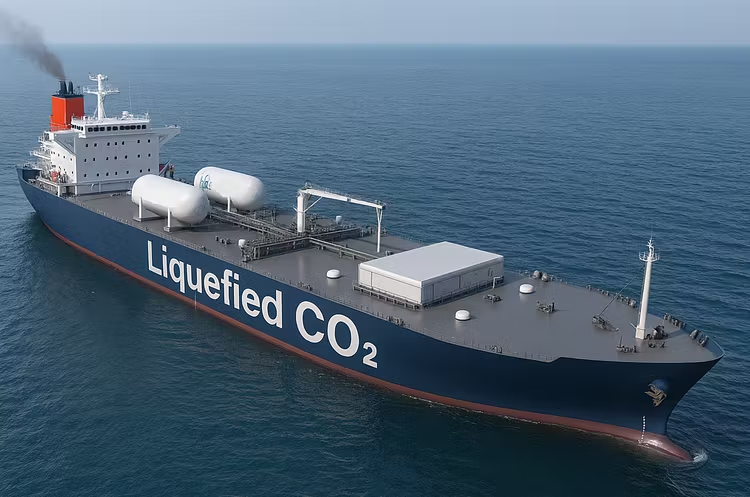
Marine Transportation of LCO₂
Specialized LCO₂ carriers transport cargo at controlled cryogenic conditions. Vessel sizes range from small shuttle carriers (~10,000 m³) to large-scale transport ships (>70,000 m³), depending on project routing, hub structure, and injection/storage rates. Maritime transport provides flexibility across increasing distances, especially where pipeline solutions are technically or economically constrained.