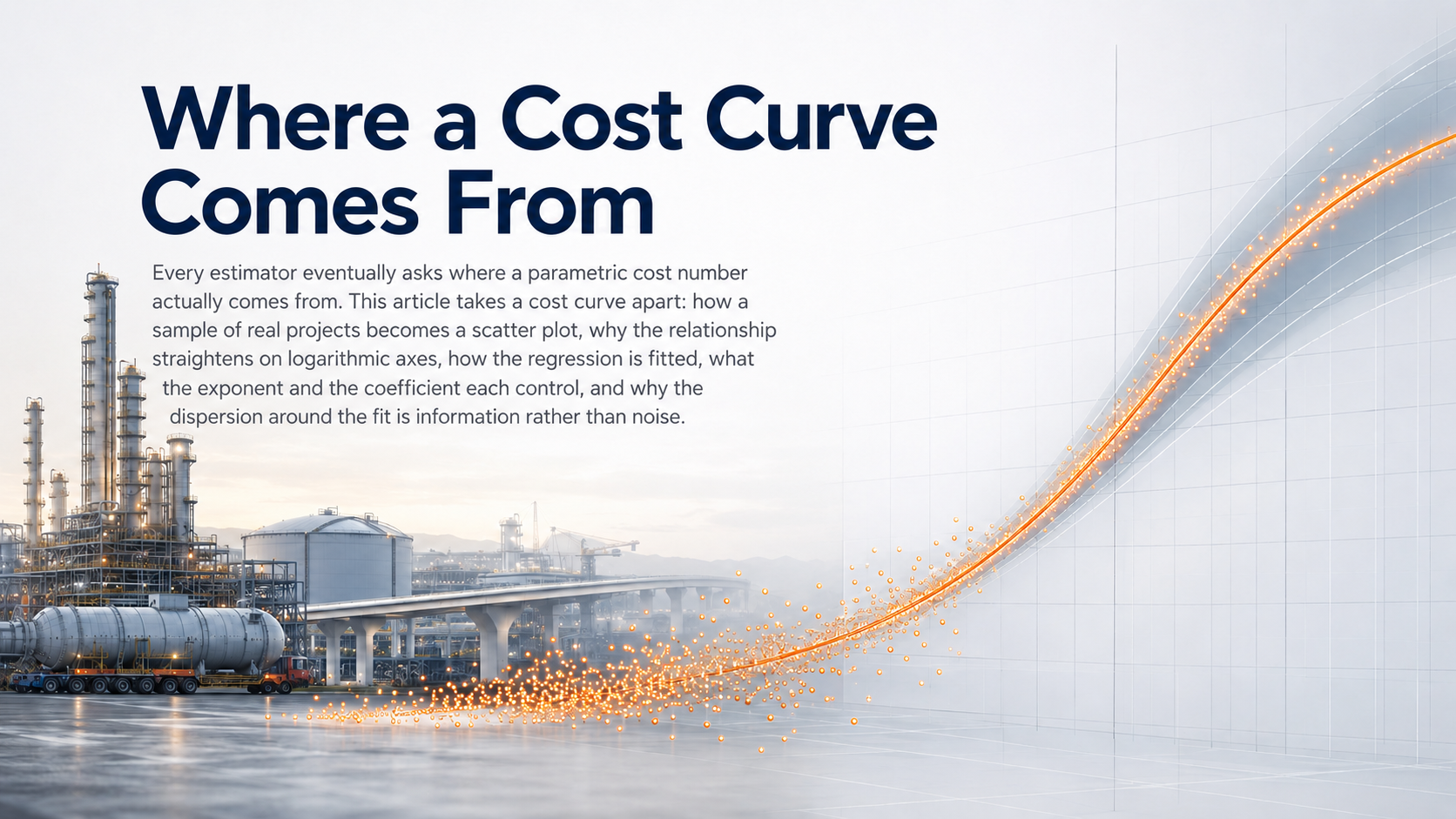
Kpex is built around an extensive, highly structured Process Plant Component Cost Database that consolidates historical project benchmarks, parametric cost curves, vendor data, and machine-learning insights.
Key characteristics of the database include:
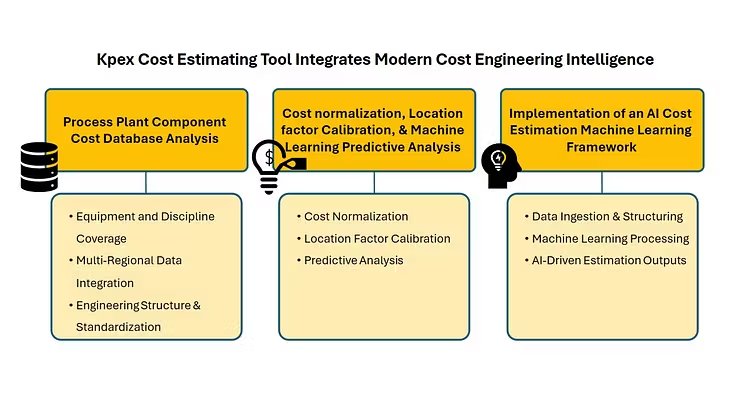
A. Equipment and Discipline Coverage
- Process equipment (vessels, tanks, exchangers, reactors)
- Rotating equipment (pumps, compressors, blowers)
- Electrical systems and power distribution equipment
- Instrumentation, controls, and automation
- Piping materials, valves, and fittings
- Civil, structural, and architectural components
- Pre-assembled packages and modular systems
B. Engineering Structure & Standardization
All equipment classes follow a unified structure based on:
- Capacity and performance parameters
- Weight-to-cost relationships
- Material of construction
- Design pressure/temperature class
- Fabrication process and complexity factors
C. Multi-Regional Data Integration
Kpex incorporates global cost signals from:
- Americas (BLS, CEPCI, producer price indices)
- Europe (Eurostat, OECD, national PPIs)
- Asia-Pacific (China NBS, Japan METI, Korea KOSTAT)
- Middle East (import-parity adjustments)
This creates a consistent dataset that supports global benchmarking and cross-project comparisons.
2. Cost Normalization, Location Factor Calibration, and Machine-Learning Predictive Analytics
Accurate cost estimation requires more than raw data. Kpex integrates a full suite of cost normalization and calibration tools that transform unbalanced, multi-region datasets into coherent cost insights.
A. Cost Normalization
Kpex automatically applies:
- Currency normalization
- Base-year indexing (Jan-2010 = 100 as the global Kpex standard)
- Material and labor inflation adjustments
- Unit and density corrections
- Specification-level alignment across equipment types
This allows for meaningful comparisons between equipment manufactured in different years or different regions.
B. Location Factor Calibration
Kpex’s Location Adjustment Engine uses:
- Regional PPIs
- Labor cost indices
- Purchasing Power Parity (PPP) factors
- Import/export pricing signals
- Construction materials indices
Each region receives a Kpex Location Adjustment Factor (KLAF), enabling cost estimators to produce geographically consistent estimates for equipment procurement, construction, civil works, and engineering services.
C. Predictive Analytics
Kpex integrates advanced machine-learning methods such as:
- Regression cost curves
- Multivariate parametric models
- Time-series escalation forecasting
- Correlation mapping between global market indices
These functions deliver:
- AI-enhanced cost predictions
- Sensitivity analysis
- Escalation scenarios
- Cost confidence ranges
3. Implementation of an AI Cost Estimation Machine-Learning Framework
The Kpex AI Framework consists of five integrated modules, ensuring that data flows seamlessly from raw input to predictive outputs.
A. Data Ingestion Layer
Automatically captures:
- Historical project data
- Vendor and OEM datasheets
- Global PPIs, labor indices, and materials indices
- Cost curves and CBS structures
B. Feature Engineering Layer
Transforms raw values into ML-ready variables:
- Equipment dimension ratios
- Pressure classes
- Material complexity multipliers
- Geographic factors
- Execution model (EPC/LSTK/Owner-led)
- Procurement lead times
C. Model Training Layer
Multiple ML models run in parallel:
- Linear regression
- Gradient boosting
- Random forest
- Neural networks
- Time series forecasting
Each discipline (piping, electrical, mechanical, civil, etc.) has a unique model optimized through hyperparameter tuning.
D. Cost Estimation Engine
Generates:
- Predictive cost ranges
- Confidence intervals
- Optimized man-hour and productivity factors
- Escalation sensitivity curves
- Cost-to-capacity benchmarks
Engineers can select:
- Deterministic mode
- Probabilistic mode
- AI-recommended mode
E. Continuous Learning Loop
Each new project, vendor quote, or benchmark is fed back into the ML pipeline, improving:
- Accuracy
- Regional calibration
- Cost behavior sensitivity
- Confidence level metrics
The more Kpex is used, the stronger and more precise its intelligence becomes.